


For you
Experienced doctors
Attention to detail, built on clinical experience.
Thermage FLX, refined to reduce discomfort while it works on firmness.
Firmness and wrinkles, addressed together.
Radiofrequency lifting refined over 17 years of clinical practice: Thermage FLX.
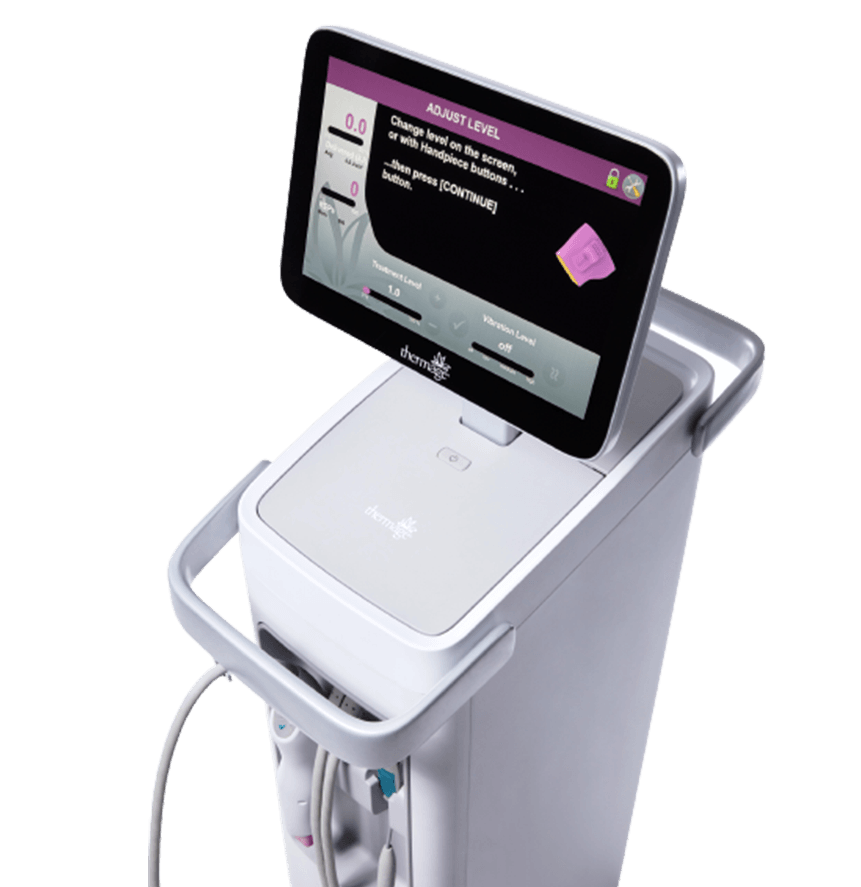
Premium Laser
Thermage FLX is a non-surgical lifting treatment that delivers radiofrequency (RF) energy deep into the dermis to stimulate collagen regeneration.
 Tightening
 Fine lines / firmness
 Collagen renewal
Thermage: Korean-made or imported, and how the lifting differs
4th-generation Thermage FLX
Using radiofrequency current, Thermage cools the epidermiswhile generating heat in the dermal tissue.
Thermage FLX, the 4th-generation evolution,is a radiofrequency treatment focused on skin tightening.Tightening, lifting and fine-line improvement
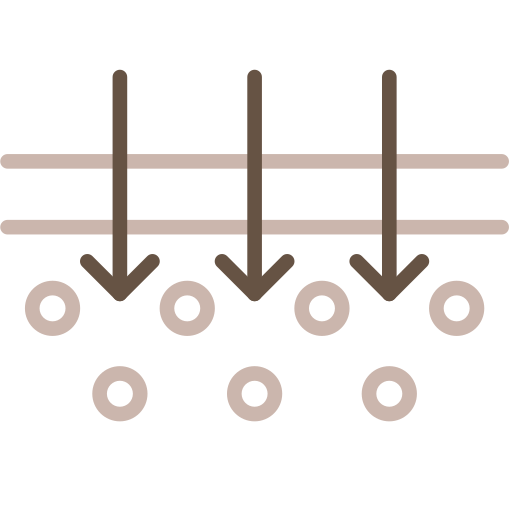
Radiofrequency energy deliveredinto the slackened dermis

Tissue coagulates,forming collagen

Collagen renewal is promoted,helping firmness and wrinkles
Faster
Speed of procedure accelerated by increasing tip area
The larger 4.0 Total Tip, with 33% more tip area,shortens treatment time by about 25%.
Algorithm
AccuREP™ to elaborate partial procedures
Automatic tuning with every shot helps deliver accurate energy to the treatment area.
Experience
Apply omnidirectional vibration and cooling system
Energy is delivered evenly, with cooling that helps protect the skin.
※ Figures are product data from the manufacturer (Solta Medical Korea). Results vary by individual.
| 3rd generationThermage CPT | VS | 4th generationThermage FLX |
|---|---|---|
| Comfort PulseTechnology | Technology | AccuREPTechnology |
| Within 1 hour | Treatment time | Within 30 minutes |
| Skintightening | Effect | Enhancedtightening |
| Somediscomfort | Discomfort | Comfort technologyfor reduced discomfort |
| KFDA 2011 / FDA 2009 | Approval | KFDA 2018 / FDA 2017 |
Focused solutions by area
Face total tip
A larger total tip than before,cutting treatment time by 25%

Dedicated eye tip
A tip made for the eye area, working gently around the eyes

The 0.25㎠ Thermage FLX eye tip is designed for softening wrinkles around the eyes and renewing collagen in the eye area and eyelids, and it works differently from eye treatment with a standard Thermage tip.
With Thermage FLX, results depend on who performs the treatment, even with the same device.17 years of clinical experience and know-how guide a precise, careful treatment.
Right after
Collagen fibers change and contract;facial contour may look tighter
After 2–3 months
New collagen forms,helping soften wrinkles
After 6 months
Improved skin density;tightening typically at its clearest
After 10 months
Firm, smooth texturetypically maintained
SYMPHONY SPECIAL
Even with the same treatment, depending on the skin it begins on, the process changes.
Better energy delivery
Hydrating the skin in advance helps radiofrequency energy travel more evenly and deeply.
Easing pain and heat
Relaxing the skin tissue helps reduce discomfort during treatment and keeps you more comfortable.
Collagen synergy
Ultrasound stimulation works together with radiofrequency energy to support the collagen renewal response.
Supporting recovery
A stronger barrier and quick calming help reduce swelling and redness after treatment and support your return to daily life.
STEP 01
Skin assessment and consultation
A detailed assessment of your skin thickness, firmness and sensitivity
STEP 02
LDM pre-care
Focused ultrasound hydrates deeper layers and activates the skin tissue
STEP 03
Tailored Thermage treatment
Performed on well-settled skin with 1:1 personalized settings
STEP 04
Post-treatment calming care
Finishing care that helps stressed skin recover
Point 02
Every Thermage tip we use is genuine. You can check the authenticity sticker and the used tip yourself before and after treatment.

Genuine Tip 01
Before treatment,the genuine tip is opened in front of you

Genuine Tip 02
Your shot countand genuine tip details, explained

Genuine Tip 03
Thermage certificateof authenticity issued
Thermage® FLX
Each Thermage® tip is used for one patient alone.
The effectiveness and safety of treatment with unapproved, illegal devicescannot be assured.Please check for a genuine tip now.
Register a genuine tip(opens in a new window · official Thermage website)
Design System
Symphony does not treat by a fixed manual.We carefully weigh how deep each treatment can clinically reach, then plan it with a custom design system for nine tissue layers.
Process — From design to shared records
01
Design
We look at skin thickness, sensitivity, firmness and how each area has aged, then design a plan around you.
02
Targeting
Depth and coverage are adjusted precisely to the nine-layer design, to make each pass count while keeping the load on your skin low.
03
Comfort
We choose the level of anesthesia to match your pain sensitivity and the treatment area.
04
Partner
Your own planner is with you from the first consultation, and your treatment records are opened and shared with you.
Not a list of machines — the things this clinic actually does while one person is being treated.
5.020 Google reviewsRead on Google
Attention to detail, built on clinical experience.

One-to-one care, planned for you.

40% off laser treatments on your return visit.

Rest in a single-occupancy care room.

A structured consultation based on skin analysis.

A dessert while you rest before heading out.

Beyond a single treatment, we offer a beginning for beauty you can sustain.Medical precision, a considered space and the rhythm of your life come together to refine your skin and your beauty with care.
