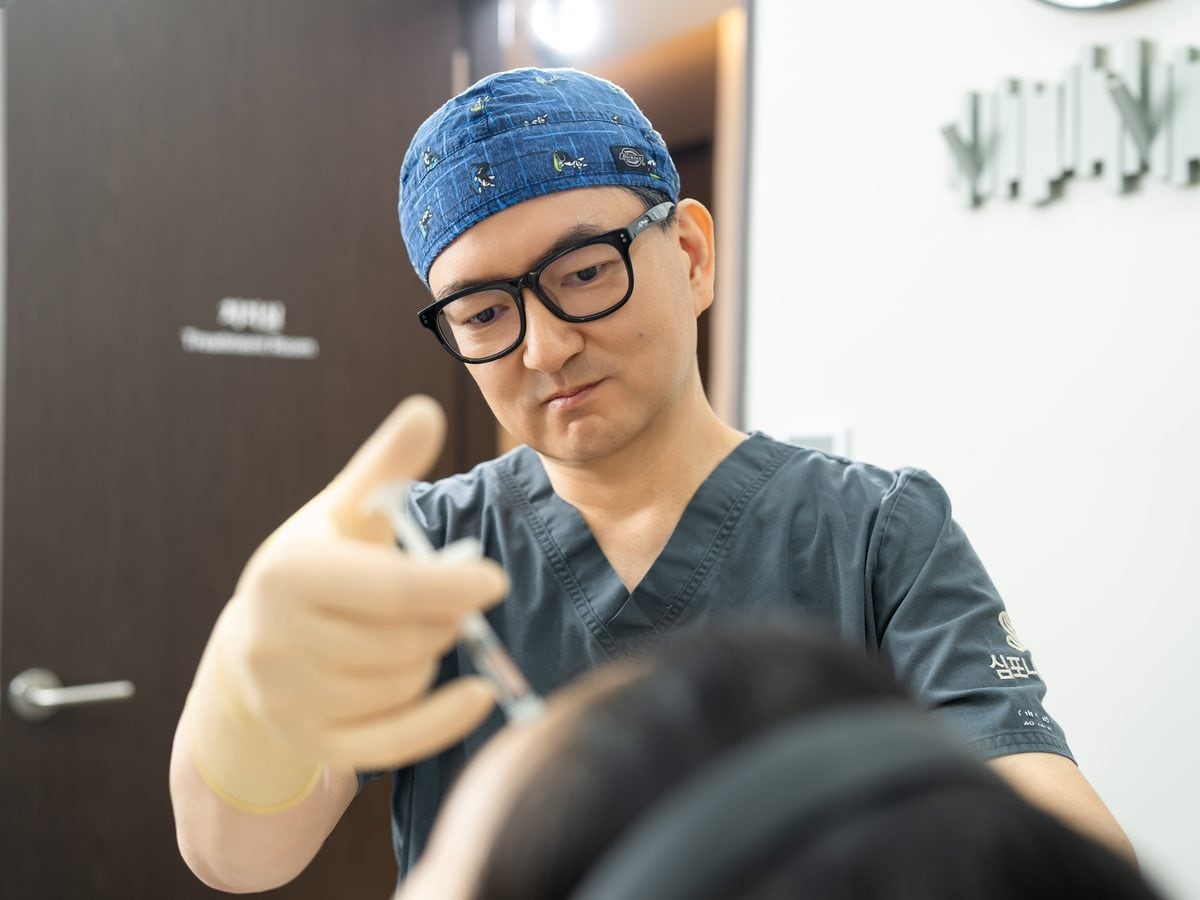
How Long Does Chin Filler Hurt For? Leave 3 Days Before Flying

Written by Dr. Hyun Kyung-bae, Chief Director · Plastic surgeon (Korea) · Reviewed by Dr. Ko Dong-il, DirectorUpdated 7 min read
In short The injection itself lasts minutes. A chin usually stays tender to press for two to three days after filler, with a dull ache at meals for up to a week if it swelled or bruised, so book it early in your Seoul trip.

How long does chin filler hurt for, once the numbing cream wears off and your flight home is only a few days away?
The needle part lasts minutes. After chin filler, the chin usually stays sore to press for two to three days, and a dull ache when you chew or talk can linger for about a week if it swelled or bruised. Put those days early in your trip and the flight home is rarely the uncomfortable part.
Hello, I'm Dr. Hyun Kyung-bae, Chief Director at Symphony and a board-certified plastic surgeon. I've practiced here for seventeen years.
At Symphony the physician who assesses your face is the one who injects, placing each product at its intended layer with a fine cannula. Treatment runs one patient at a time in a private room, and a medical interpreter for your language stays with you from reception to the treatment room at no extra charge.
How long does chin filler hurt for after the first night?
In short, this is the usual pattern for an uncomplicated chin:
| When | What it usually feels like | What helps |
|---|---|---|
| The injection, about 10-20 minutes | Pressure and short stings under numbing cream | Slow breaths out; saying so if one spot stings |
| First evening | Numbness fades into a tight, dull ache | A cold pack wrapped in cloth, a few minutes at a time |
| Days 1-3 | Tender to touch, sore when chewing; swelling peaks | Soft food, sleeping on your back |
| Days 4-7 | Tender only under firm pressure | Your normal routine, no kneading |
| Up to two weeks | Any bruise fades; the gel may feel firm | Nothing, unless pain starts rising |
Makeup and face washing are possible right after a filler session, and daily life resumes the same day.
Why does the soreness outlast the needle?
Numbing cream and the lidocaine many hyaluronic acid fillers contain cover the injection. The later soreness is tissue reacting to tiny punctures and to gel stretching the space it was placed in, and that swelling builds overnight.
A treated chin behaves like a shin you knocked on the coffee table. Sit still and you forget it; press it, bite into a bagel or pull a wide smile and you remember. For many people that press-sensitivity fades within two to three days.
Which chins stay sore longer?
Gel placed deep on the bone to add projection stretches more tissue than a small touch near the surface, and a chin often takes more volume than lips. The mentalis muscle works every time you talk or chew, so the ache shows up at meals. A bruise adds days, and aspirin, fish oil or wine the night before make one more likely. Old acne scars on the chin are a separate question; how a doctor reads acne scars before choosing a treatment covers that layer.
Since the amount drives so much of the soreness, send one side-profile photo of your chin on WhatsApp, taken in daylight with your teeth together, and ask how much filler a chin like yours usually takes. That number lets you plan your days around your own chin. One photo is enough to start.
Which day of a Seoul trip should the injection go on?
Early in the stay, with at least three nights between the injection and your flight. The tender days then pass in Seoul, and the chin you board with only aches if you press it.
Choose a weekday if you can. Symphony is closed on Sundays and Korean public holidays, including the days around Lunar New Year and Chuseok, so after a Saturday injection the first day you could walk back in is Monday, right after soreness peaks. Weekday hours are 10:00 to 19:00 and Saturday 10:00 to 17:00, and the address and the walk from Sinsa Station are on the Symphony Dermatology home page.

Cabin pressure doesn't shift hyaluronic acid, so for an uncomplicated chin the flight is about comfort. Keep a travel pillow behind your neck, where it can't ride up under the jaw, and avoid dozing with your chin propped in your hand.
The thing travelers forget is the dentist. Dental work stretches the lower face and can carry bacteria into nearby tissue, so many injectors suggest leaving roughly two weeks between dental appointments and filler, on either side. If a cleaning at home is booked for the week you land, move it.
The first 48 hours: eating, sleeping and moving
Plan soft meals for the first day or two: noodles, porridge, tofu, anything that doesn't need a hard bite at the front of the mouth. Drinking from a cup works the chin less than pursing your lips around a straw.
Sleep on your back with an extra pillow, which keeps swelling from pooling and keeps the chin off the mattress. Hard workouts, saunas and alcohol are commonly put off for about 24 to 48 hours because extra blood flow adds swelling and bruising; a long walk through a neighborhood is fine the same afternoon.
Leave the chin alone otherwise. Makeup can go on gently, but don't massage or press the area to check it unless you've been told to, since firm handling in the first days can move gel that hasn't settled.
Pain that is not part of normal recovery
To be honest, day-two tenderness is not what I watch for. What matters is a pattern that doesn't match the table above.
The U.S. Food and Drug Administration lists pain, tenderness, swelling and bruising among the common risks of dermal fillers, and these usually settle within one to two weeks. The rare serious problem is filler entering or pressing on a blood vessel. Its signs are pain that is severe or keeps climbing, skin over the chin or lower lip turning pale, blotchy or dusky, and, very rarely, changes in vision. That is urgent: hyaluronic acid can be dissolved with an enzyme, and hours count. Infection looks different, with heat, spreading redness and pain that returns after a few good days.
Wait for another trip if you're pregnant or breastfeeding, or have an active breakout or cold sore near the chin, a recent dental infection or procedure, or a known allergy to lidocaine or a filler ingredient. Blood thinners raise the chance of bruising; keep taking any that are prescribed and mention them beforehand.
Once you're back home, aftercare for English-speaking patients stays in the same WhatsApp chat as questions and booking, so a photo of a chin that looks wrong goes there. Pale or darkening skin, or any change in vision, goes first to an emergency department at home: tell them you had hyaluronic acid filler and when.
How sore you get depends on your tissue, the amount placed and how you heal, so read the table as the common pattern; your own days may run shorter or longer.
Is chin filler sorer than Rejuran, Juvelook or Ultherapy?
People often pair a chin with skin or lifting treatments on one trip, and each leaves a different kind of soreness.
Rejuran is a skin treatment and not a filler: many tiny injections that leave small bumps, which usually flatten in one to three days. The tenderness is spread across the surface, without one deep sore spot. If it's on your list, which part of a Rejuran price you're choosing explains how that quote is built.
Juvelook is chosen on different grounds from hyaluronic filler. It prompts your own collagen, so there's little to see on the day and the change shows over weeks. It's planned for skin and volume, and it isn't a tool for projecting a chin.
Ultherapy is focused ultrasound below the skin. Along the jawline its discomfort sits mainly in the session itself, and some people stay tender for a few days. Booked beside chin filler, that means two sore areas meeting at the jaw, so ask about the order and the spacing. The questions worth asking before booking Ultherapy and what changes an Ultherapy quote cover the rest.
Where I stand on chin filler and soreness
Nothing here needs settling this week. A chin that has bothered you for years can wait for a trip with room for those quiet days.
To start, send that same side-profile photo on WhatsApp, in daylight with your teeth together, and ask how much filler a chin like yours usually takes. You can ask before booking anything.
Dr. Hyun Kyung-bae, Chief Director
Questions patients ask us
Can I take a painkiller after chin filler?
Acetaminophen (paracetamol) is the usual choice for the first days. If you take a blood thinner for a medical reason, keep taking it and mention it before treatment.
Does the lidocaine in filler mean I won't feel anything?
It dulls the injection and roughly the first hour. With numbing cream applied first, you'll feel pressure and short stings more than pain. The tenderness that arrives the next day is the tissue's reaction, and lidocaine has worn off by then.
Is it normal for the chin to feel firm or a little lumpy?
For the first week or two, often yes. Hyaluronic acid draws in a little water while it settles, so the chin can feel firmer than the skin around it and slightly uneven to touch. A lump that is hot, red and getting more painful is different and needs a photo sent the same day.
What if one side of my chin feels sorer than the other?
That's common in the first days, since one side may have had an extra entry point or a small bruise. Uneven tenderness that is easing each day is fine. One side getting hotter, redder or more painful over time is not, and should be checked.
Will a second round of chin filler hurt as long as the first?
Not necessarily. A top-up usually places a smaller amount than a first treatment, and less gel means less stretch, so the tender phase is often shorter. A bruise can still add a few days either time.
What decides the cost of chin filler?
Mainly the product and how much your chin needs, then whether the chin is treated alone or together with the jawline. There is no single price for a chin, and the final plan and cost are confirmed by the physician after the in-person examination. A side-profile photo is the starting point for asking about your own case.
Sources
- Dermal Fillers (Soft Tissue Fillers)
- Fillers
- Dermal Fillers
- Minimizing Bruising Following Fillers and Other Cosmetic Injectables (Hamman & Goldman, 2013)
Treatment details: Symphony Skin Clinic treatment information, checked Nov 22, 2026.
This page is general information from Symphony Skin Clinic, not a diagnosis. Results, risks and recovery differ by person. Treatment is decided after an in-person consultation with a licensed doctor. Clinic and treatment photos on this page were taken at Symphony Skin Clinic.
Keep reading
- Scar / Stretch MarkAcne scar treatment in Korea: what a doctor reads before choosing anythingHow acne scar treatment in Korea is planned: the four scar shapes a doctor reads first, and why Symphony pairs needle-free Mirajet delivery with Juvelook.8 min read
- Skin BoosterRejuran in Korea: a skin treatment that is not a fillerRejuran korea explained by a Seoul clinic: what polynucleotide does, why it is not a filler, and how Rejuran, Rejuran i and Rejuran HB differ from each other.8 min read
- Skin BoosterWhat Rejuran costs in Korea, and which part of it you are choosingRejuran korea cost in three parts: medication, delivery route and optional comfort. In-house range 300,000 to 700,000 KRW a session, VAT 10% charged separately.7 min read